IDP Ecosystem Guidelines
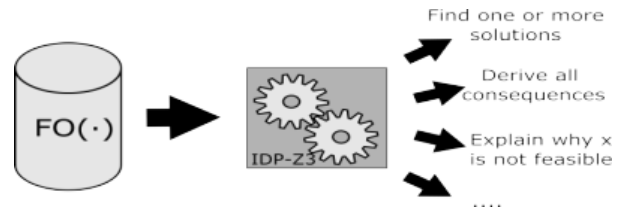
IDP-Z3 is a knowledge-base system that allows users to create a knowledge base over which a reasoning engine can perform inference tasks. It is characterised by its strict adherence to the knowledge-base paradigm, according to which a complete separation must be sought between the knowledge and any type of execution logic. This guideline provides an overview of the main tools available in the IDP ecosystem.
IDP-system versions
The current version of IDP is IDP-Z3, which uses Z3 as a solver in the background. The latest version of IDP-Z3 can be installed from its Github repository. Demos and a tutorial can be found here. It is also possible to run IDP-Z3 online here. An older version of IDP that is still in use, is IDP3.
Input
The standard input formalism for IDP-Z3 is the FO(.) language. FO(.) is a conservative extension of first-order logic. Details regarding its syntax are available in the documentation . A good starting point to learn the language, is this tutorial .
Several alternatives exist to conveniently transfer knowledge to a knowledge base that can be used by IDP-Z3. CDMN was created to have a low learning curve, since it is based on the DMN standard.
Another tool to create a visual representation of the knowledge are feature models.
Finally, KeBAP (Knowledge-base API for Python) provides tools to import data from (simple) CSV-files. It is also capable of translating between the IDP3 and IDP-Z3 dialect of FO(.). Future extensions will also allow RDF-triples as input.
User Interface
IDP-Z3 has a default user-interface, known as the Interactive Consultant. This interface allows users to select options and automatically see what can be inferred from their choices. If items become irrelevant, they are greyed out. If the system is able to obtain an exact value, this will also be shown. Users can also learn the remaining possible values for a constant by opening a dropdown menu.
Demo
Several demos can be found in the Interactive Consultant under the tab File -> Examples. A demo for a laptop webshop is also available. Note that it might be more efficient to download the demo and run it locally, to avoid delays caused by the server.
| Speaker | Title | Date | Location | Info |
|---|
| Multiple | Recent Trends in Applied AI | 24th October 2024 | KU Leuven - Campus De Nayer | See more |
| Joost Vennekens | A No-Code Approach to Decision Support and Knowledge Capturing | 24th May 2024 | Brugge | See more |
| Evgeny Kharlamov | Decision-Making for Manufacturing with Knowledge Graphs | 23rd April 2024 | Leuven | See more |
| Multiple (Find here ) | Current Trends in AI | 17th April 2024 | Brugge | See more |
| Simon Vandevelde, Ioannis Dasoulas | KG3D Learning and Reasoning Webinar | 26th February 2024 | Online | See more |
Companies Involved


